
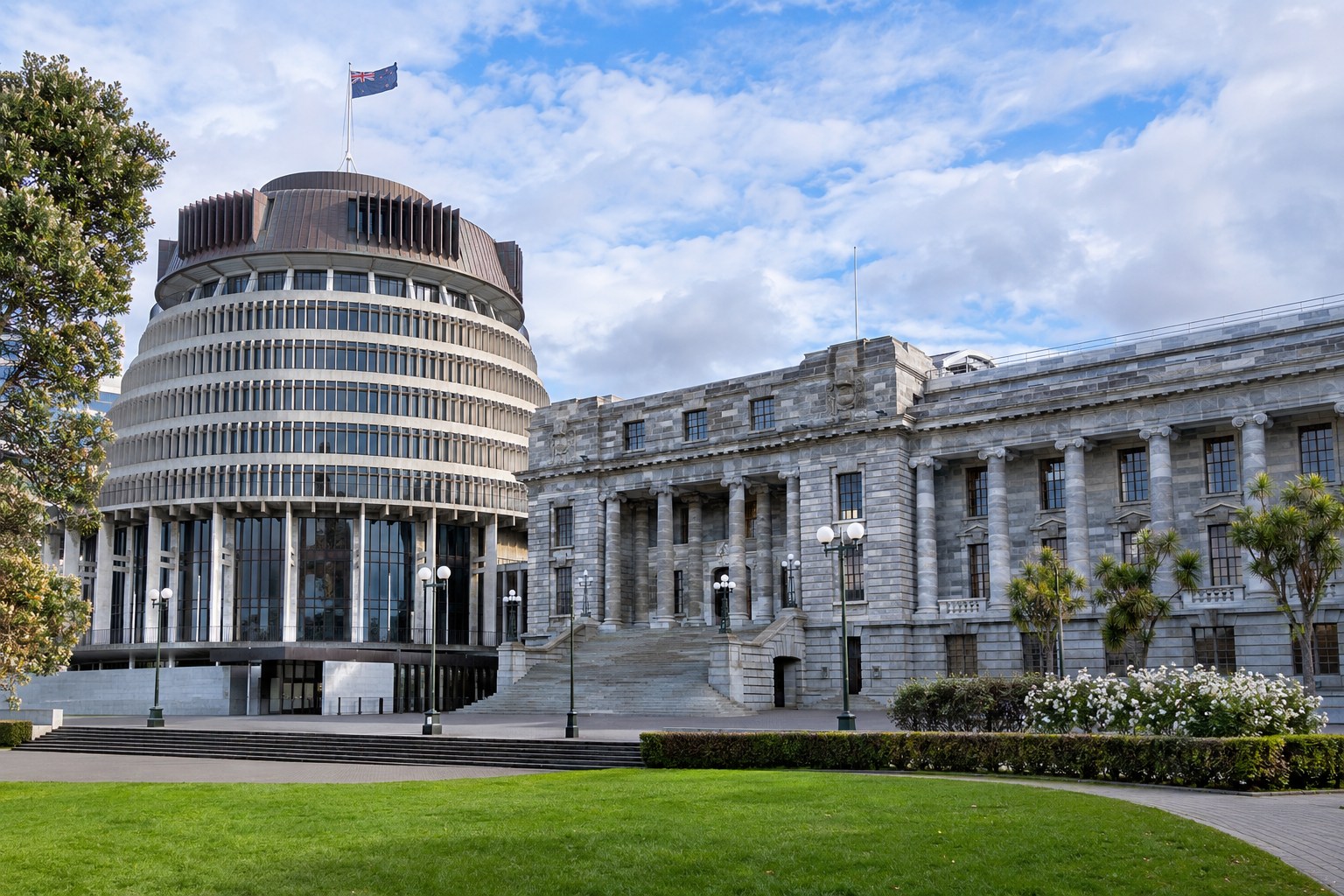
New Zealand's 7 November election has left the next government unsettled. With special votes still outstanding, joblessness has risen, inflation remains above the Reserve Bank's target, an NCEA exam failure has disrupted students, and new residence rules are affecting migrant families.
The preliminary result gives National, ACT and New Zealand First 67 seats in a projected 131-seat Parliament, one above the majority threshold of 66. Special votes could change that. The official count is due on 27 November; Christopher Luxon's government remains subject to caretaker conventions in the meantime.
Election 2026: why the government remains undecided
The Electoral Commission's preliminary count gives the National Party 42 seats, Labour 36, the Green Party 16, ACT New Zealand 13, New Zealand First 12, the Opportunity Party seven and Te Pāti Māori five. Labour led National in the party vote, 29.36% to 29.21%, but National won more electorate seats.
Together, National, ACT and New Zealand First have 67 projected seats. Labour, the Greens and Te Pāti Māori have 57; including Opportunity's seven would make 64. About 399,365 special votes, including votes cast overseas, have yet to enter the official count. A handful of changes could alter the coalition arithmetic.
Mixed-member proportional representation (MMP) has also produced a projected 11-seat overhang. National won more electorate seats than its party-vote allocation would normally allow. Te Pāti Māori leads in five of the seven Māori electorates despite polling below 1% in the nationwide party vote. Parliament therefore stands to expand from its usual 120 seats to 131. Prime Minister Christopher Luxon and Labour leader Chris Hipkins face different paths to a majority. Opportunity leader Qiulae Wong, whose party cleared the 5% threshold in the preliminary count, could be decisive if the present governing bloc loses a seat. No coalition deal follows automatically from the seat projections.
Te Ao Māori News reported stronger preliminary margins for wāhine Māori candidates Hana-Rāwhiti Maipi-Clarke in Hauraki-Waikato and Oriini Kaipara in Tāmaki Makaurau. Their results also bear on Māori representation and debate over Te Tiriti o Waitangi.
The election timetable has the official result on 27 November and the return of the writ on 3 December, subject to recounts. Parties can hold talks before then, but they will not know the final seat totals until counting is complete.
Cost of living and jobs remain central to the national outlook
Stats NZ recorded unemployment at 5.7% in the September 2026 quarter, up from 5.6% in June. Its Household Labour Force Survey counted roughly 174,000 unemployed people. Underutilisation, which also captures people wanting more hours of work, reached 13.8%.
Annual inflation slowed to 3.7% in the September quarter from 4.1% in June. It remained above the Reserve Bank of New Zealand's 1–3% target. Electricity was 9.3% dearer than a year earlier, local authority rates and payments 6.2% higher, and petrol 19.1% higher. Slower inflation does not reverse those price rises.
Wage-rate inflation ran at 2.1% over the September year, against consumer-price inflation of 3.7%. The measures are not identical, but the gap helps explain the strain on pay packets. Commuting, rent and employment costs differ across Auckland, Wellington, Canterbury and smaller centres. Whoever governs next will confront a weak labour market alongside high power, petrol and rates bills. An official cash rate change will not settle every household cost.
Migration is rising, even as New Zealand citizens continue to leave
Stats NZ migration estimates released on 12 November show a net gain of 22,600 people in the year to September 2026: about 136,100 arrivals and 113,500 departures. New Zealand citizens recorded a net loss of 37,800; non-citizens recorded a net gain of 60,400. Those provisional figures can change as more movements are recorded. They also capture a familiar split: inward migration continues even as New Zealanders head overseas, often towards jobs and family across the Tasman. A positive total does not mean the citizen exodus has stopped.
A change to residence instructions took effect on 12 November. Under Immigration New Zealand's revised instructions, parents and other secondary applicants cannot be granted residence while a dependent child is unlawfully in New Zealand. The old rules still apply to applications lodged before 12 November. Officials must give applicants a chance to respond to concerns about a child's immigration status before deciding.
Green MP Ricardo Menéndez March raised concerns for families with disabled children. Caretaker Immigration Minister Erica Stanford said the change would prevent inconsistent immigration outcomes within a family. Depending on eligibility, declined applicants retain appeal rights before the Immigration and Protection Tribunal. The filing date and the child's status are therefore material to individual cases.
NCEA exam disruption puts digital assessment under scrutiny
A failure of the New Zealand Qualifications Authority's online system disrupted thousands of students sitting NCEA Level 2 English on 12 November. Students and teachers reported trouble opening exams and fears that work had not saved. NZQA said it restored the system by 10.35am.
In its formal response, NZQA offered a derived grade to students at schools with digital entries. It will also mark completed exam work and award whichever grade is higher. Schools can raise cases of particular disruption. Post Primary Teachers' Association president Chris Abercrombie criticised the workload for schools. NZQA chief executive Christian Hawkesby apologised and said further system checks were under way. Caretaker Education Minister Erica Stanford said students should not be disadvantaged. The grading remedy leaves questions about lost time and the reliability of online exams.
Healthcare access, medicines and the limits of faster approvals
Difficulty getting a timely GP appointment affected 25.5% of adults surveyed for the Ministry of Health's Health and Independence Report 2025, published in September 2026. Another 14.9% cited cost as a barrier to primary care. The figures reflect earlier patient experiences, not waiting lists as at November.
On 12 November, the Ministry of Health reported that Medsafe had approved a generic paliperidone injection for schizophrenia and schizoaffective disorder. The agency took 25 working days, using a pathway that checks medicines previously assessed by two recognised overseas regulators. Medsafe said it cut about ten months from its usual assessment work. Medsafe approval does not guarantee public funding. Pharmac makes separate purchasing and funding decisions; stock availability and clinical suitability also affect access. Faster regulatory assessment is one issue. Getting a GP or specialist appointment is another.
Abuse-in-care survivors mark two years since the national apology
On the National Day of Reflection, 12 November, survivors marked two years since the Crown apologised for abuse and neglect in state and faith-based care. The Royal Commission of Inquiry into Abuse in Care made more than 200 recommendations. Survivors gathered near Parliament in Wellington demanding accountability and redress.
Survivor advocate Ken Clearwater said the apology had not gone far enough and called for independent redress. The Crown's November response update introduced a single-claim option for people harmed across more than one state agency, alongside the State Redress service. Independence remains a point of dispute between survivors and the Crown.
On 13 November, Privacy Commissioner Michael Webster highlighted guidance on sharing information when children's safety or wellbeing is at risk. The guidance addresses an immediate question for agencies; it does not replace oversight, adequate staffing or the obligation to protect children in care.
Auckland congestion charging moves into consultation
Auckland is weighing time-of-use charges on congested roads. Auckland Council puts the region's annual congestion cost at about $2.6 billion. Its three proposed schemes range from a central-city charging area to options covering major motorway routes.
The consultation closes on 11 December 2026. Modelled peak-period charges run from roughly $2 to $7. No scheme has been approved. Some councillors have questioned whether residents can clearly reject all three options; a final design and start date remain some years away. For people travelling across Tāmaki Makaurau, the detail will matter: public transport alternatives, exemptions, travel time saved and who pays most. The proposals also test how New Zealand's largest city intends to fund and manage its road network.
Scam losses and organised crime put safety in focus
A 2026 survey by the Global Anti-Scam Alliance and Netsafe estimated scam losses among New Zealand adults at $503.5 million over the previous year. Of 1,180 respondents, 83% had encountered a scam; 44% of those exposed had interacted with one. Email, texts and phone calls were common contact channels.
The 2026 loss figure should not be compared directly with the higher 2025 estimate: the survey methodology changed. The survey still records widespread exposure, despite respondents' confidence in their ability to spot scams.
Separately, New Zealand Police reported two arrests after searching properties at Warkworth, north of Auckland, on 13 November. Officers reported a suspected clandestine methamphetamine laboratory, firearms, ammunition and drugs. The accused are due before the North Shore District Court; the allegations have not been proved.
El Niño raises different summer risks across the country
A strong El Niño is shaping the summer outlook. In its November 2026 to January 2027 seasonal forecast, Earth Sciences New Zealand, incorporating NIWA, favoured drier conditions in the north and east of the North Island, particularly Gisborne, Hawke's Bay and Wairarapa. Wetter conditions were favoured on the West Coast, in Fiordland and in Southland.
A seasonal forecast describes probabilities across three months, not the timing of a drought, flood or storm. Farmers and councils making water decisions still need local forecasts and official severe-weather warnings.
The dates to watch after the election
The 27 November count will show whether National, ACT and New Zealand First retain their 67-seat position or have to negotiate more widely. The return of the writ is scheduled for 3 December, subject to recounts. NZQA still faces further digital assessments, and Auckland’s congestion-charge consultation closes on 11 December. Later economic and migration releases will show whether the latest trends in prices, jobs and departures persist.